
AI Resume Builder Bullet Points: Turning Job Duties Into Achievements
«Responsible for» bullets tell a recruiter what your job was; achievement bullets tell them how well you did it. Turning one into the other means adding a measurable result to whatever you already did — no rewrite works without a number attached, according to resume-writing guidance published by CareerOneStop, the career resource sponsored by the U.S. Department of Labor. An AI resume builder can rewrite a flat duty into a sharp draft in seconds — but the number that makes it convincing has to come from you.

This guide breaks down what actually separates a duty from an achievement, the formulas that convert one into the other (XYZ, action verb + task + result, STAR/PAR/CAR), how to quantify a bullet when you don’t have exact figures, and five real before/after rewrites across five industries.
Duties vs. Achievements: What’s Actually Different
A resume bullet can describe two very different things, and most job seekers only ever write the first kind.
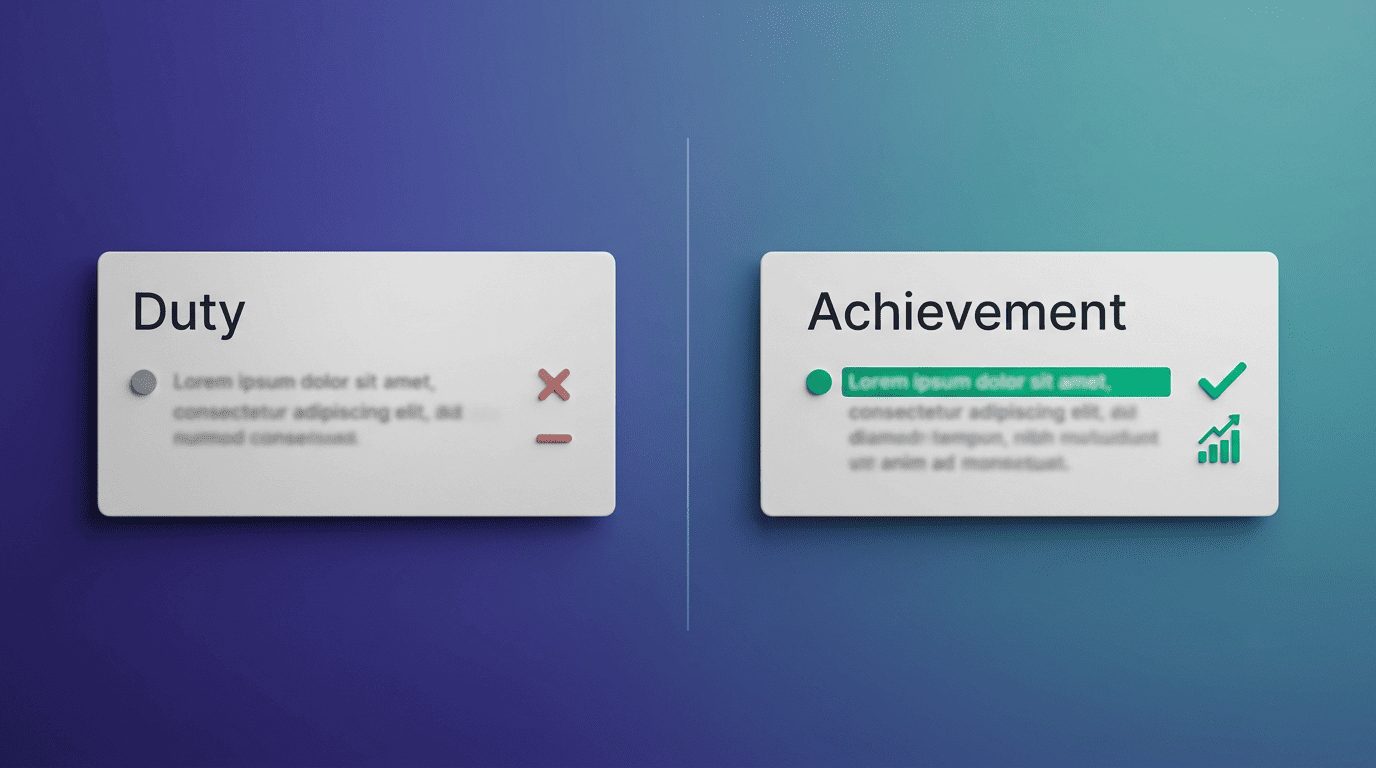
A duty is what you did; an achievement is how well you did it
A job duty describes the role: «Responsible for handling customer complaints.» An achievement bullet describes the outcome: «Resolved 95% of complaints within 24 hours, improving customer retention 23%.» Both sentences are true, but only one gives a hiring manager a reason to call you. A recruiter scans a resume for roughly six to seven seconds before deciding whether to keep reading, and a CareerBuilder survey of hiring managers found that a resume with no quantifiable results is an instant dealbreaker for around 34% of them. Achievement bullets differentiate you from every other applicant who held the same job title; duty bullets make you sound interchangeable with them.
The gap matters just as much for applicant tracking systems as for humans. An ATS ranks resumes partly on keyword and skill matches, but the achievement bullet still does the persuading once a person opens the file — the two functions aren’t in conflict, they’re sequential. SHRM, the Society for Human Resource Management, advises digging for a measurable result on every accomplishment line, since a bullet with no number is far easier for a tired reviewer to skip past.
The Core Formula: Action Verb + Task + Measurable Result
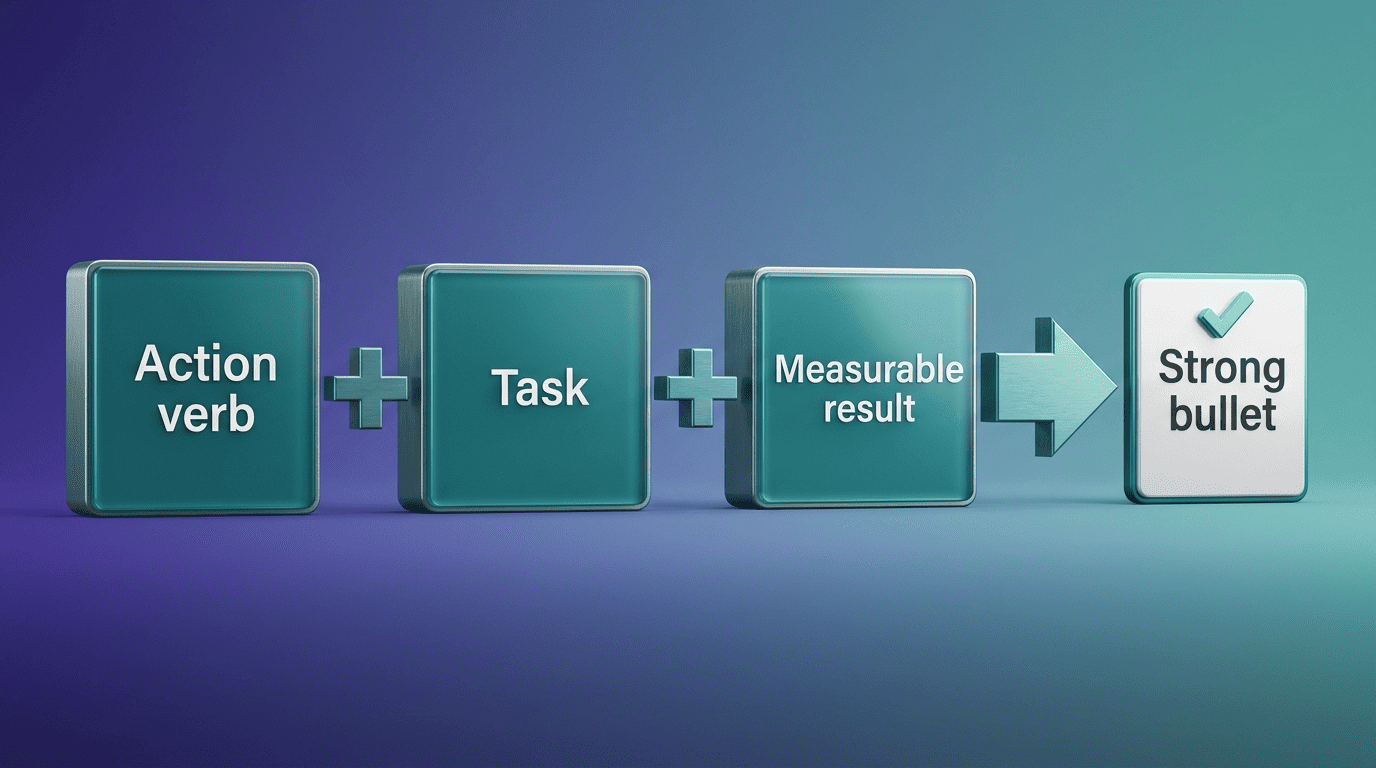
Every strong achievement bullet, regardless of industry, is built from the same three-part skeleton.
The one-line formula every strong bullet follows
Start with a specific action verb, name what you did it to or for, and close with a measurable result. In practice: «Increased customer retention by 25% over six months by improving the onboarding process.» Open with a verb like Led, Grew, Reduced, Launched, or Generated — never with «Responsible for,» «Helped,» or «Worked on,» which describe presence, not performance. A bullet that starts with a weak verb almost never recovers, even if the result later in the sentence is strong — recruiters skim the first two or three words of every line, so that’s where the achievement has to announce itself.
A handful of verbs cover most achievement bullets across industries:
- Leadership and ownership: Led, Directed, Spearheaded, Managed
- Growth and improvement: Grew, Increased, Boosted, Expanded
- Efficiency and cost: Reduced, Cut, Streamlined, Optimized
- Creation and launch: Built, Launched, Designed, Architected
- Revenue and results: Generated, Closed, Delivered, Secured
The XYZ formula (the Google-recruiter version)
A widely cited variant, popularized by Laszlo Bock, Google’s former SVP of People Operations, is the XYZ formula: «Accomplished [X] as measured by [Y] by doing [Z].» It forces you to lead with the result, attach a number to it, and only then explain the method. Example: «Increased website traffic by 40% in three months by launching a targeted content strategy.» The order matters — putting the metric before the method is what makes the sentence scannable in the six-to-seven-second window a recruiter actually gives it.
There’s a simple formula. Every one of your accomplishments should be presented as: ‘Accomplished [X] as measured by [Y] by doing [Z].’
Laszlo Bock, former SVP of People Operations, Google
Turn a duty into a bullet in five steps
- Write down the raw duty exactly as it sits on your current resume or job description.
- Pick one strong action verb that starts the sentence — Led, Built, Reduced, Launched, Grew.
- Identify which of the five metric categories (money, time, volume, people, performance) applies to the task.
- Pull the actual number from a performance review, dashboard, or honest estimate with a baseline.
- Assemble the pieces in XYZ order: result first, metric second, method last, then read it back to check it lands inside a six-to-seven-second scan.
How to Quantify — Even When You Don’t Have Exact Numbers
The single biggest reason job seekers skip quantification isn’t laziness — it’s that they don’t think they have real numbers to use. Almost everyone does.
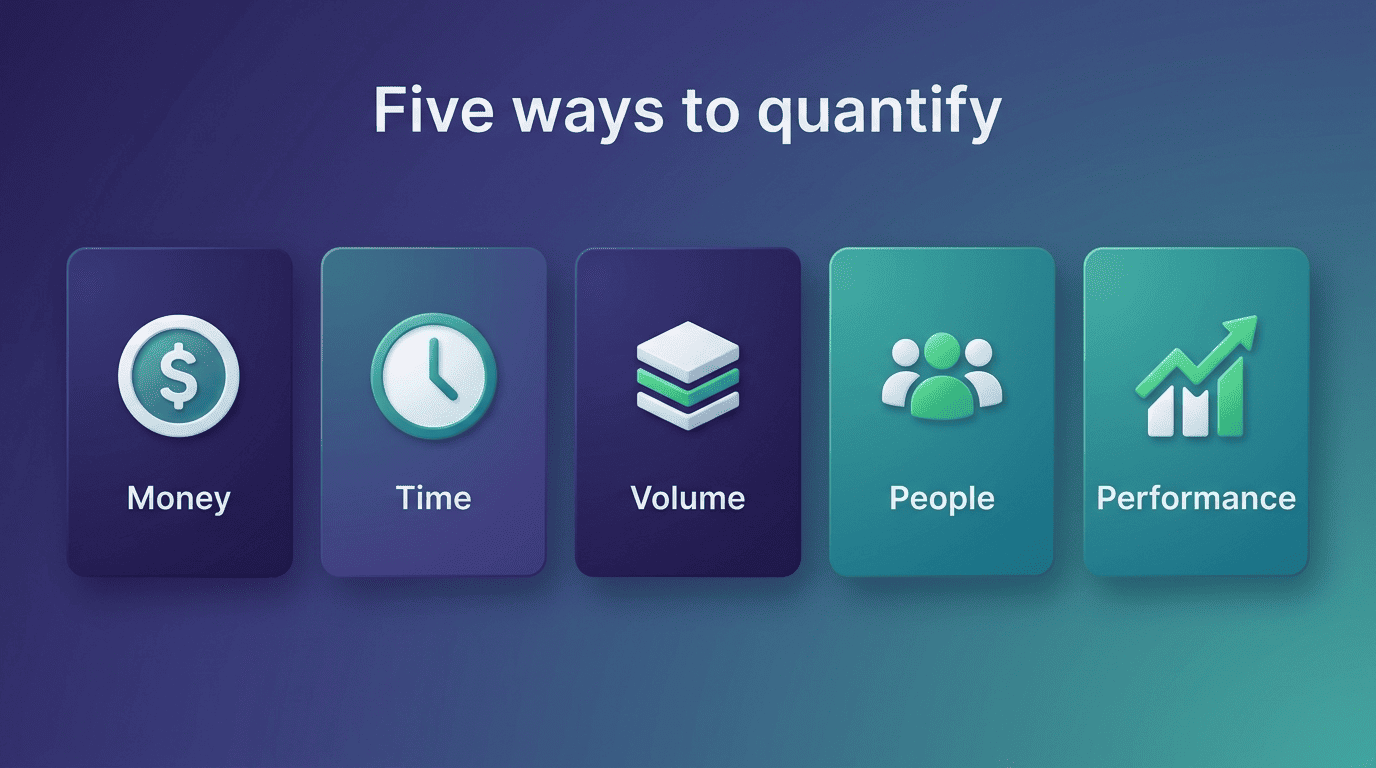
Five kinds of numbers you can always find
Nearly every job produces data in one of five categories:
| Metric type | What it captures | Example bullet fragment |
|---|---|---|
| Money | Revenue, savings, budget managed | «cut vendor costs by $45,000 annually» |
| Time | Speed, deadlines, turnaround, frequency | «reduced onboarding time from 3 weeks to 5 days» |
| Volume | Tasks, tickets, clients, units handled | «processed 200+ invoices per month» |
| People | Team size, audience reached, users served | «trained a team of 8 new hires» |
| Performance | Percentages, ratings, KPIs, scores | «raised customer satisfaction score from 3.8 to 4.6» |
Percent change is a simple calculation: ((New − Old) / Old) × 100. Going from $1,000 to $1,500 in monthly sales is a 50% increase — that single number is more persuasive than a paragraph describing the same growth in words.
A quick source check before you write the bullet usually turns up more numbers than you expect:
- Performance reviews and self-assessments from the past two years
- Team or department dashboards (sales, support tickets, project trackers)
- Calendar or email records showing project timelines and deadlines hit
- Budget or expense reports you managed or contributed to
- Manager or client feedback that references specific results
No hard data? Estimate honestly
If you genuinely can’t pull an exact figure, an honest approximation still outperforms a duty bullet with no number at all. A few honest qualifiers do the job without inventing false precision:
- «Approximately» or «roughly» — for figures you’re confident are close but not exact
- «More than» or «over» — for a conservative floor you can defend if asked
- «Averaging» — for results that varied month to month or project to project
- A tilde (~) before a number — for a quick, scannable estimate
Whenever possible, give a baseline so the number has context: «grew membership from 50 to 100 active users» or «increased quarterly revenue from $6M to $7.3M» reads as more credible than «increased revenue» alone, because it shows the starting point, not just the endpoint.
Recruiters and resume coaches consistently flag vague quantification as a red flag — a result only reads as credible when it’s anchored to a specific, checkable reference point, not a floating percentage with no starting line.
Expanded Methods: STAR, PAR, and CAR
The verb + task + result formula works for a single-line bullet, but some achievements are complex enough that they need a short story to land.
STAR — Situation, Task, Action, Result. Use it when the context matters as much as the outcome: what was happening, what you were asked to do, what you actually did, and what changed as a result. It’s the format interviewers expect verbally, and it compresses well into two dense resume lines.
PAR — Problem, Action, Result. A tighter three-part version that skips situational scene-setting and jumps straight to the problem you were solving, which suits a resume better than a full STAR narrative.
CAR — Challenge, Action, Result. The most compact of the three and the best fit for a single bullet point, since «challenge» folds the problem and its stakes into one clause. A CAR-shaped bullet might read: «Initiated and wrote the first training manual for the company’s data-tracking system, cutting new-hire training time in half — still in use company-wide.»
All three methods are describing the same underlying move: name the obstacle, name the action, quantify the outcome. Pick whichever compresses most naturally for a given achievement rather than forcing every bullet into the same three-letter mold.
Before & After: Real Bullet Makeovers by Industry
Seeing the formula applied across different roles makes it easier to apply to your own experience — the mechanics don’t change, only the metric category does. The table below lines up the flat duty against the rewritten achievement for five common roles, using the same verb + task + result skeleton every time.
| Industry | Before (duty) | After (achievement) |
|---|---|---|
| Retail | Assisted customers with purchases | Drove a 25% increase in monthly sales through proactive upselling, earning 90% positive customer feedback |
| Marketing | In charge of social media accounts | Grew Instagram following from 5,000 to 25,000 in six months, driving a 34% increase in referral traffic |
| Project management | Managed projects for the team | Led a team of 12 to deliver a $2M initiative two weeks ahead of schedule and under budget |
| Software engineering | Developed backend APIs | Architected 14 REST APIs serving 2.3M daily requests at 99.97% uptime, cutting average latency from 340ms to 45ms |
| Customer service | Handling customer complaints | Resolved 95% of complaints within 24 hours, improving customer retention by 23% |
Notice the pattern in every row: the «after» version keeps the same underlying work but adds a number, a timeframe, or both. Nothing in the achievement column is a different job — it’s the same duty, described with evidence instead of a title.
Common Mistakes That Kill an Achievement Bullet
Adding a number doesn’t automatically make a bullet strong. A handful of habits routinely undermine bullets that otherwise had a real result to report.
Taking team credit instead of individual credit. Writing «we increased sales 20%» tells a recruiter nothing about your specific contribution. Use «I» language implicitly — «Increased sales 20% by restructuring the outreach process» — even if the win was a group effort; the recruiter is evaluating you, not your former team.
Writing in passive voice. «Sales were increased by 20%» buries the actor. Passive constructions read as vague even when they contain a real metric, because the reader has to work to figure out who did what.
Using vague quantifiers instead of numbers. «Significantly improved efficiency» or «handled many client accounts» sound like metrics but aren’t. Replace «many» with an actual count and «significantly» with an actual percentage or timeframe.
Skipping the baseline. A number with no starting point — «increased revenue 15%» with no dollar figures — is weaker than one that shows both ends of the change.
Quantifying every single bullet. A resume where 100% of bullets carry a metric starts to look manufactured rather than genuine. The 3-5 bullet rule per role, with at least one or two quantified, keeps the metrics feeling earned rather than inflated.
Including achievements that don’t relate to the target role. A quantified win that has nothing to do with the job you’re applying for wastes prime resume real estate that a relevant, less-flashy result would fill better.
How an AI Resume Builder Helps (and Where It Doesn’t)
Use AI to draft, use your numbers to close
An AI resume builder is genuinely useful for the mechanical part of this process: it can take a flat «Responsible for managing client accounts» and instantly rewrite it into an achievement-shaped draft, suggest a stronger opening verb, and hold the verb + task + result structure consistently across every bullet on the page, often tailoring the phrasing toward the job description you’re applying to. A free AI resume builder can run this rewrite pass across an entire resume in the time it would take to manually edit two or three lines by hand.

What it can’t do — and shouldn’t try to do — is invent the metric. The AI has no way of knowing that your onboarding project actually cut training time by 40%, or that your sales numbers moved from $6M to $7.3M; that data lives only in your memory, your performance reviews, or your team’s reporting dashboard. The honest workflow is to let an AI-powered resume builder handle structure, verb choice, and formula consistency, while you supply the real, checkable number every single time. A polished bullet with a fabricated statistic is a bigger liability in an interview than an honest duty bullet — because the first question a hiring manager asks about an impressive number is «how did you get there?»