
AI Resume Builder Keyword Optimization: How to Tailor Your Resume to the Job Description
Every job posting is a keyword list in disguise, and the applicant tracking system on the other side is quietly checking how many of those words appear on your resume. An AI resume builder reads the job description, finds the keywords that matter, and rewrites your resume so it speaks the recruiter’s exact language.

This guide walks through how keyword optimization actually works, how ATS software ranks resumes (and which parts of that process are myths), a step-by-step way to tailor a resume to a single job in minutes, and how to add keywords without tipping into keyword stuffing.
What Keyword Optimization Actually Means for Your Resume
Keyword optimization is the process of matching the exact terms in a job posting — skills, tools, certifications, job titles — with the terms already on your resume, then filling the gaps. It is not about tricking software; it is about proving, in the software’s own vocabulary, that you can do the job.
Keywords are the language recruiters and software share
Keywords are the concrete, nameable pieces of a job: programming languages like Python or SQL, methodologies like «project management,» credentials like PMP, or platforms like Google Analytics. Both the ATS and the recruiter doing a manual scan — which an eye-tracking study by career site Ladders measured at 6 seconds in 2012, rising to 7.4 seconds in a 2018 follow-up — are hunting for exact or near-exact matches to these terms, not a paraphrased version in your own words.
That is why the same skill written two different ways can score differently. A resume that says «led cross-functional teams» may never surface for a posting asking for «stakeholder management,» even though the two phrases describe the same work. Keyword optimization closes that gap.
- Hard skills: named tools, languages, platforms, and technical methods (Python, Salesforce, GAAP)
- Certifications and licenses: PMP, CPA, Six Sigma, RN
- Job titles: the exact title used in the posting, even if your last title differed
- Soft-skill phrases: terms like «stakeholder management» or «cross-functional leadership» that show up in the posting’s language, not generic synonyms
Hard skills beat generic buzzwords
Hard skills carry more weight than generic soft-skill buzzwords such as «team player» or «hard worker,» because they are measurable and directly tied to the job’s tasks. The frequency of a term inside the job description is itself a signal of importance: if «stakeholder management» appears three times in a 400-word posting, it is a first-priority keyword, not an afterthought to sprinkle in once.
This is also where semantic match starts to matter more than raw keyword overlap. Modern parsing tools increasingly look at whether a term appears in a context that makes sense — a skill listed under «Experience» with a matching bullet point carries more signal than the same word dropped into an unrelated sentence.
How ATS Ranks Your Resume — and the Myths to Drop
An applicant tracking system, as described on Wikipedia, is software that employers use to collect, sort, and filter resumes before a human ever opens them. Most of what job seekers believe about how that filtering works is outdated or exaggerated.
What the ATS really does with keywords
The ATS parses a resume into structured fields — contact info, work history, skills, education — and compares those fields against the job requisition, often producing an internal match or relevancy score that recruiters can sort by. Most large employers now run applications through one of a handful of platforms:
- Workday — the most widely used ATS among Fortune 500 companies, according to the Society for Human Resource Management
- Greenhouse — common among mid-size and high-growth employers
- iCIMS — widely used in enterprise recruiting
- Oracle Recruiting (which absorbed the legacy Taleo platform) — common in large, established organizations
Whichever platform an employer runs, the underlying workflow looks about the same at every step:
| ATS step | What it checks |
|---|---|
| Parsing | Splits resume into structured fields (name, dates, skills, titles) |
| Keyword matching | Compares parsed skills/titles against the job description |
| Scoring | Assigns a match or relevancy percentage recruiters can sort by |
| Ranking | Surfaces top-scoring resumes first in the recruiter’s queue |
The auto-reject myth
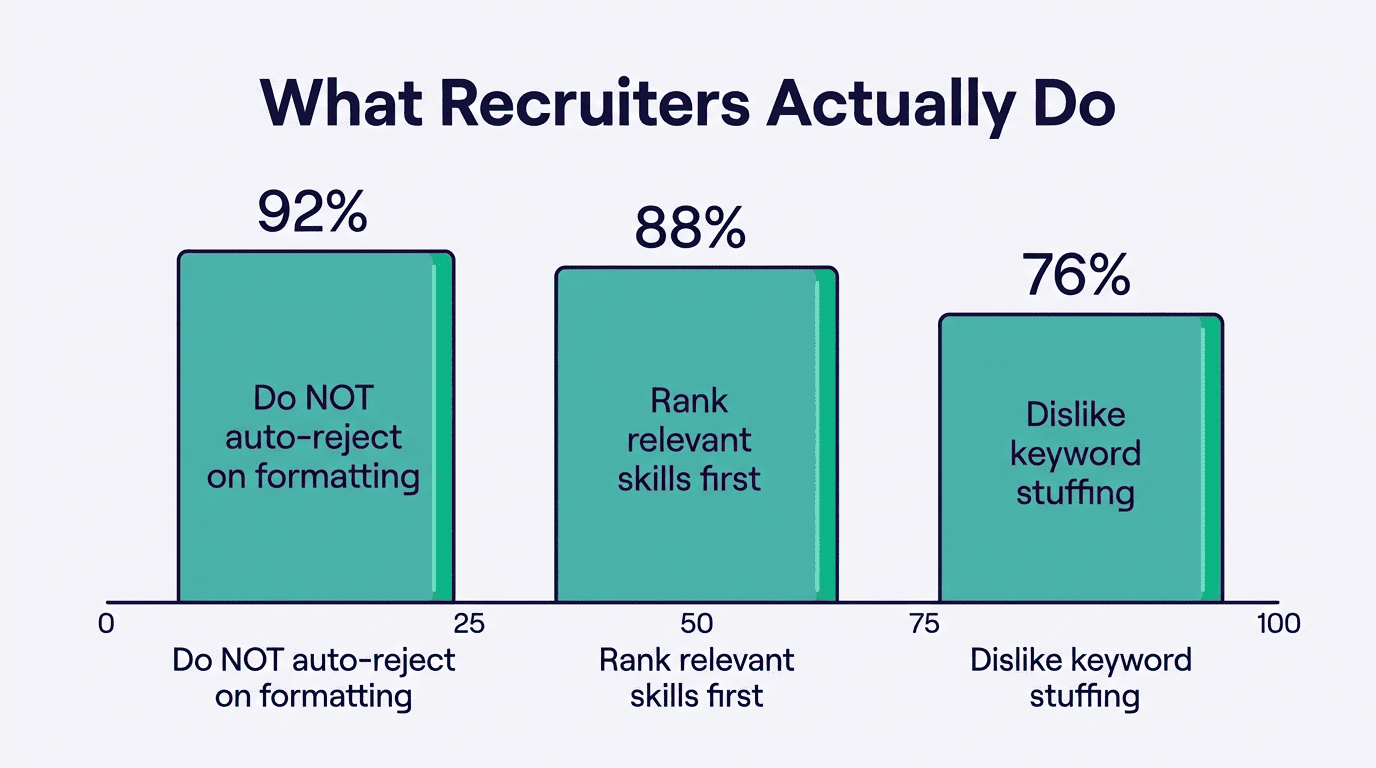
A 2025 survey of 25 US-based recruiters found that 92% do not use automatic rejection based on resume formatting alone, 88% rank relevant skills above every other factor, and 76% say they are turned off by obvious keyword stuffing. The takeaway is that the goal of tailoring is relevance, not gaming a robot — the robot mostly ranks; a person still decides.
That skimming behavior is exactly what the Ladders eye-tracking study set out to measure. As the company’s own CEO put it when the updated findings were released:
The findings of this new study underline the extent to which resume-skimming behaviors impact not only a job seeker’s chances of being noticed, but also a company’s ability to spot qualified candidates.
Marc Cenedella, CEO of Ladders, Inc.
Keyword optimization exists to close that gap: to make the handful of seconds a resume gets count in the applicant’s favor instead of against it.
How an AI Resume Builder Extracts Keywords From a Job Description
Pasting a job description into an AI resume builder tool turns a wall of text into an actionable, prioritized list — the same analysis a recruiter or ATS would run, done in seconds instead of a manual read-through.
Paste the job description, get a prioritized keyword list
Once the job text is in, the tool highlights the keywords your resume is missing, groups them by category (hard skill, certification, tool, soft-skill phrase), and shows where each one fits — summary, skills section, or a specific bullet point. Some free tiers surface only a handful of top keywords, while full versions return the complete list along with an overall match score.
It rewrites using only what’s true
A well-built tool rewrites the phrasing of your existing bullets using only information already present in your resume — it should never invent a certification or a tool you have never used. The resulting match score is a proxy for how closely your document now mirrors the posting’s language, not a guarantee of an interview, but a useful signal of how much work remains.
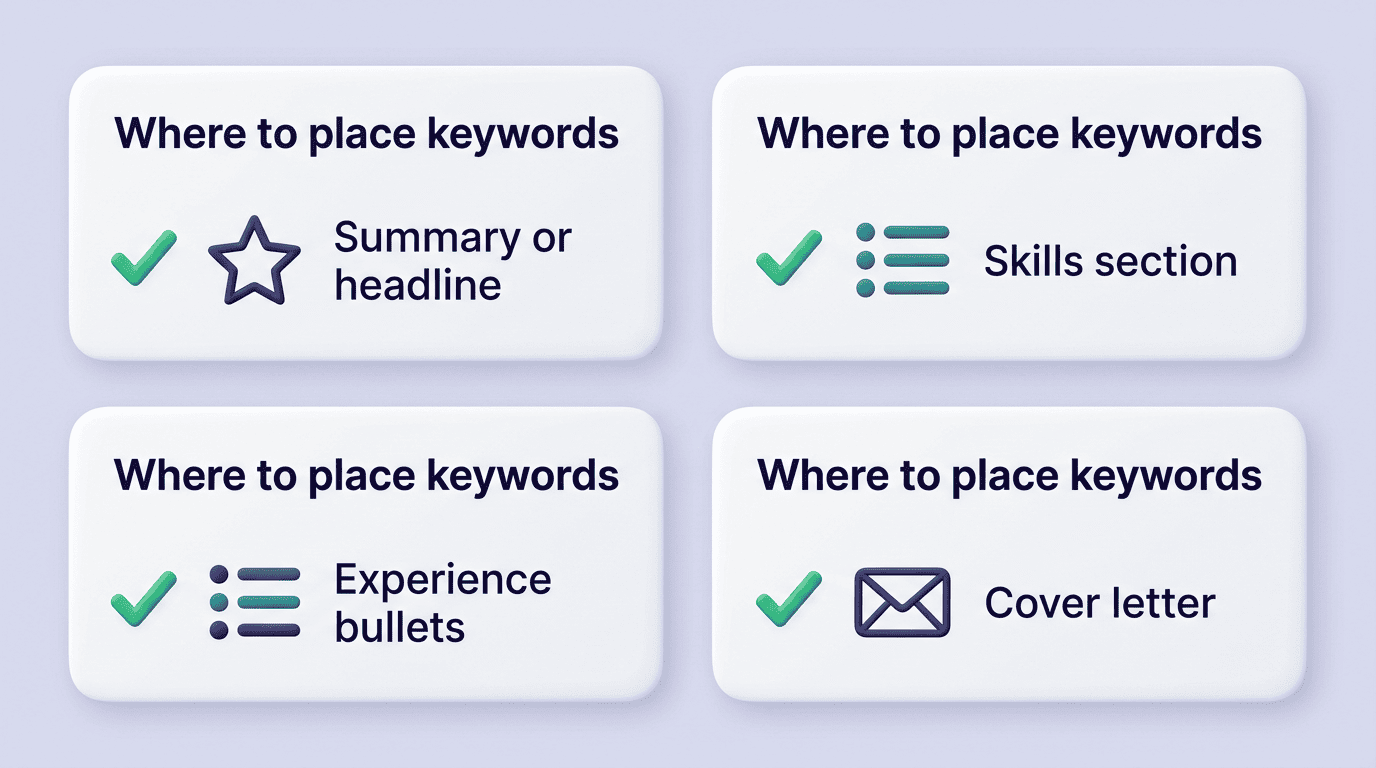
The U.S. Department of Labor’s CareerOneStop resume guide recommends the same discipline for anyone doing this by hand: identify the terms a posting repeats, then place the ones you genuinely qualify for where they will actually be read. In practice, that means spreading keywords across a few specific spots rather than dumping them in one place:
- Summary or headline — the one or two keywords that define the role itself (the exact job title, the core tool)
- Skills section — the hard skills and certifications an ATS scans for first
- Experience bullets — keywords paired with a specific, quantified accomplishment
- Cover letter, when one is required — a natural place for phrases that would feel forced on the resume itself
Step by Step: Tailoring Your Resume to One Job
Manual tailoring — reading a posting, hunting for gaps, rewriting bullets by hand — typically takes 30 to 60 minutes per application. An AI resume builder compresses that into a handful of targeted edits.
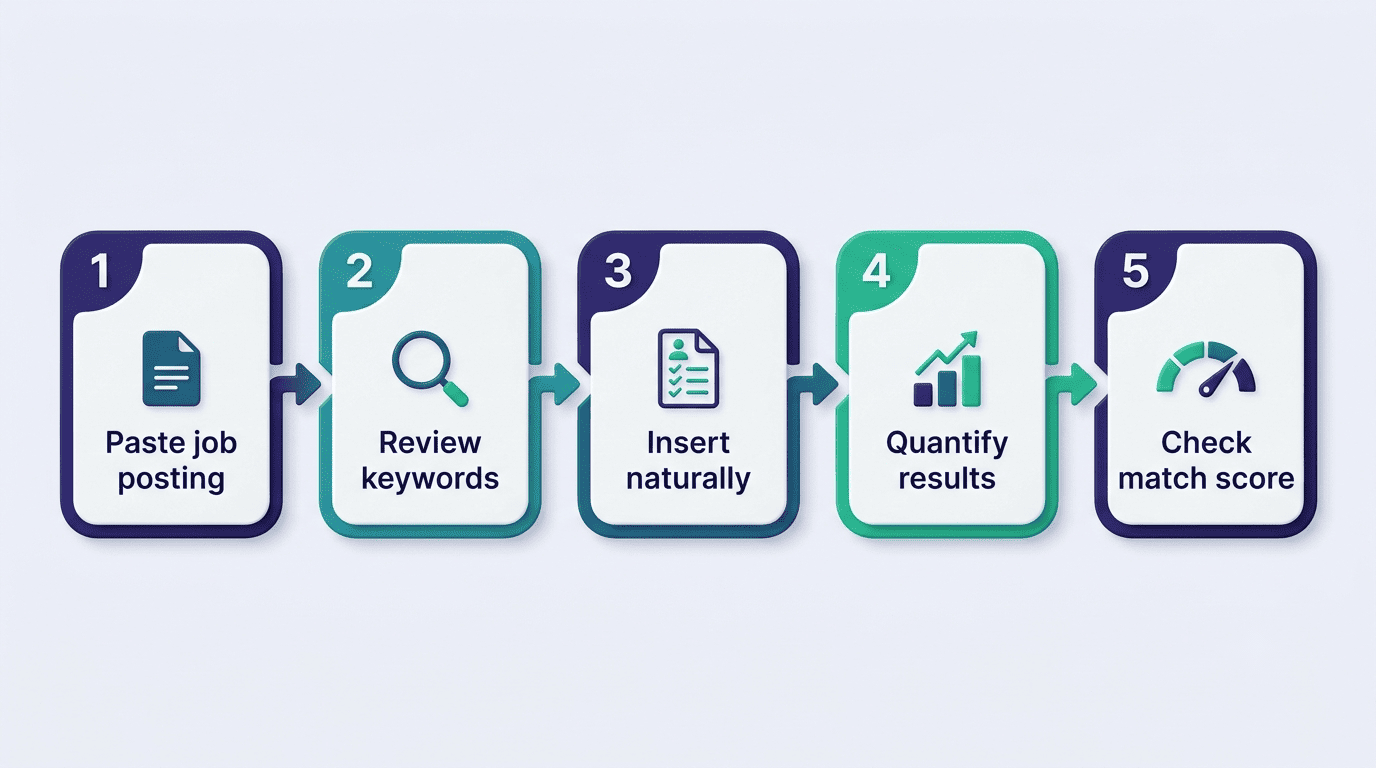
- Paste the full job posting into the builder.
- Review the missing hard-skill keywords it surfaces, and accept only the ones that genuinely apply to your background.
- Work the accepted keywords into your summary, skills list, and relevant bullet points — naturally, not as a dumped list.
- Quantify the achievements those keywords sit inside, adding numbers, percentages, or dollar figures wherever you can.
- Re-check the match score, then repeat the process for the next job posting.
Done this way, tailoring usually means 5 to 10 line-level edits and takes under 5 minutes, compared with the 30 to 60 minutes a fully manual pass requires.
Quantify, don’t just insert
A keyword works harder when it lives inside a quantified achievement rather than sitting alone in a skills list. «Cut reporting time 40% by automating Excel dashboards» outperforms «Responsible for Excel» on every measure that matters — it contains the keyword, proves the skill, and gives a recruiter a number to remember. Pairing a keyword with a metric satisfies both the parsing software and the human reading the shortlist afterward.
Job seekers who tailor each application this way, rather than sending one generic resume to every posting, consistently report a higher rate of callbacks, since the resume is answering the specific question each posting is asking rather than a generic one.
Avoiding Keyword Stuffing (the #1 Way Tailoring Backfires)
Keyword optimization has a failure mode: cramming in every possible term until the resume reads like a list rather than a career. That approach tends to backfire with both software and people.
What stuffing looks like — and why it fails
- Repeating the same keyword a dozen times across summary, skills, and bullets
- Hiding keywords in white text or font sizes too small to read
- Listing skills or tools you have never actually used
- Copy-pasting entire phrases from the posting without connecting them to real experience
Recruiters notice this pattern quickly, and the survey cited above found 76% react negatively to it. Meanwhile, parsing systems have moved toward evaluating semantic match — whether a term appears in a context that makes sense — rather than a raw count of how many times a word shows up. A resume built this way, one that stays close to a natural keyword density, tends to read as credible to a machine and a human at the same time. The safer approach is to build a resume with AI that flags gaps without pushing you to overload the document.
The right density
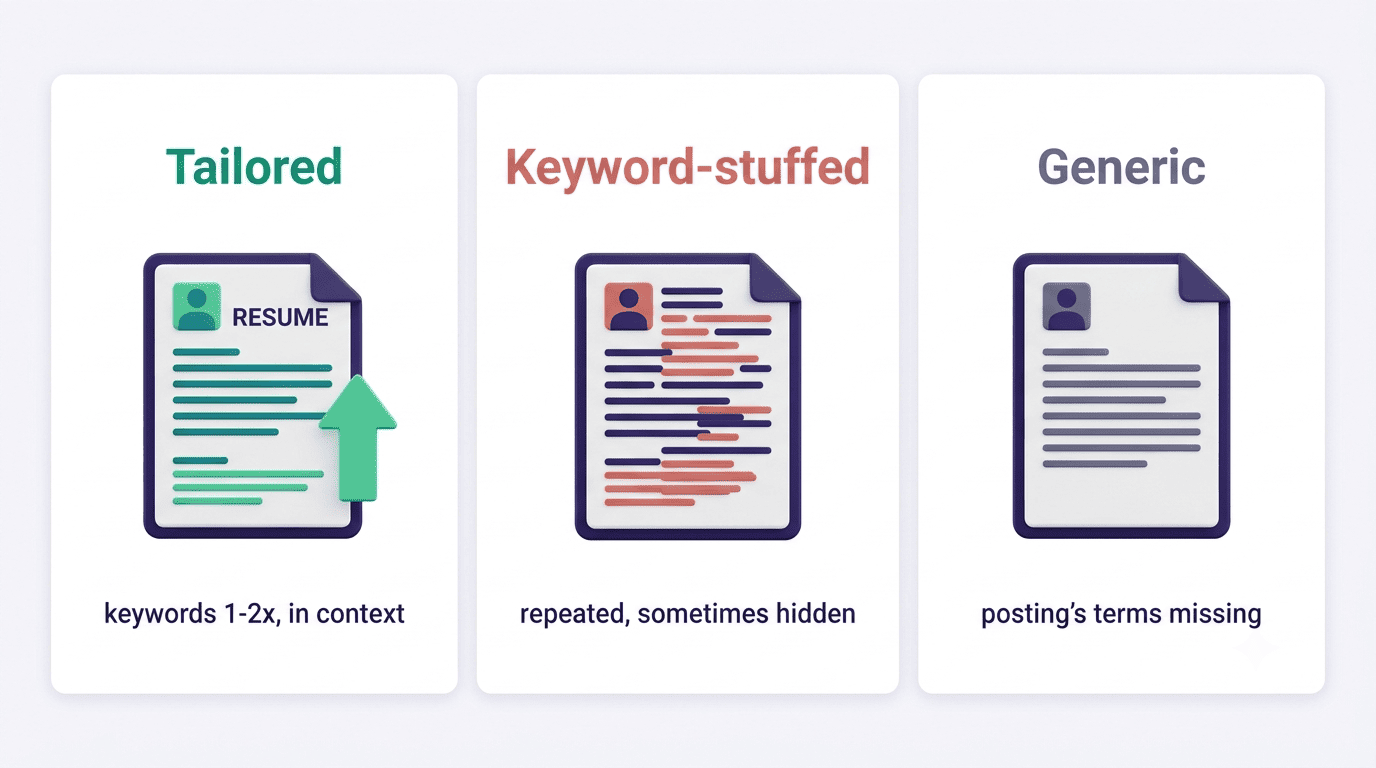
Each important keyword should generally appear once or twice, placed in a context that supports it — a line in the skills section, backed by a matching bullet in the experience section. The priority is relevance and truthfulness, not maximizing the raw count of matches, because the recruiter reading the shortlist is the one who ultimately decides whether to call.
| Approach | Keyword pattern | Typical outcome |
|---|---|---|
| Tailored resume | Each priority keyword appears 1–2 times, in context | Higher match score, reads naturally to a recruiter |
| Keyword-stuffed resume | Keywords repeated many times, sometimes hidden | Flagged by recruiters, semantic match stays low |
| Generic, untailored resume | Posting’s exact terms mostly absent | Low match score, resume ranks lower in ATS queue |