
AI Resume Builder vs ChatGPT: Which Builds a Better Resume?
Both tools can draft resume text, but they solve different problems. A dedicated AI resume builder produces ATS-friendly formatting and a submission-ready file, while ChatGPT is a general-purpose model that writes wording but leaves layout, structure, and keyword targeting to you. CareerOneStop, the resume guide sponsored by the U.S. Department of Labor, notes that most employers are now supportive of job seekers using AI to help write or edit a resume — which is exactly where formatting and keyword matching start to matter.

For a finished, ATS-safe resume the builder wins on formatting and speed; ChatGPT wins on brainstorming and phrasing; the highest interview rates come from combining them.
The Core Difference: Purpose-Built Tool vs General-Purpose Model
An AI-powered resume builder and ChatGPT are not competing on the same axis. One is a platform built end-to-end for a single job; the other is a language model that happens to be useful for many jobs, resume writing included.
What an AI resume builder actually is
An AI resume builder is a purpose-built platform built around the whole hiring pipeline, not just text. A typical dedicated resume tool bundles:
- Guided fields that walk you through each resume section
- ATS-tested templates in a single-column layout
- Keyword matching against a specific job description
- One-click PDF export in a parser-safe file format
The builder knows what a parser expects — headings, single-column structure, standard section labels — and enforces that structure automatically, so the applicant doesn’t have to learn ATS formatting rules to benefit from them.
What ChatGPT actually is
ChatGPT is a general-purpose language model, and the same is true of competing models like GPT-4o from OpenAI and Claude from Anthropic. It drafts and rewrites text well, but it has no built-in template, no ATS scoring, and no guaranteed export format. Writing the sentences is only one part of the resume problem — selection, framing, and formatting are the rest, and those are where a general model leaves gaps. Head-to-head tests of ChatGPT against Claude on resume phrasing generally score the two close to each other, which underlines that the gap between the two categories of tool isn’t about which model writes better sentences — it’s about everything a resume needs beyond sentences.
Round 1 — ATS Compatibility (Who Actually Passes the Filter)
Before a human ever opens a resume, software usually reads it first. That single fact decides more callbacks than word choice does.
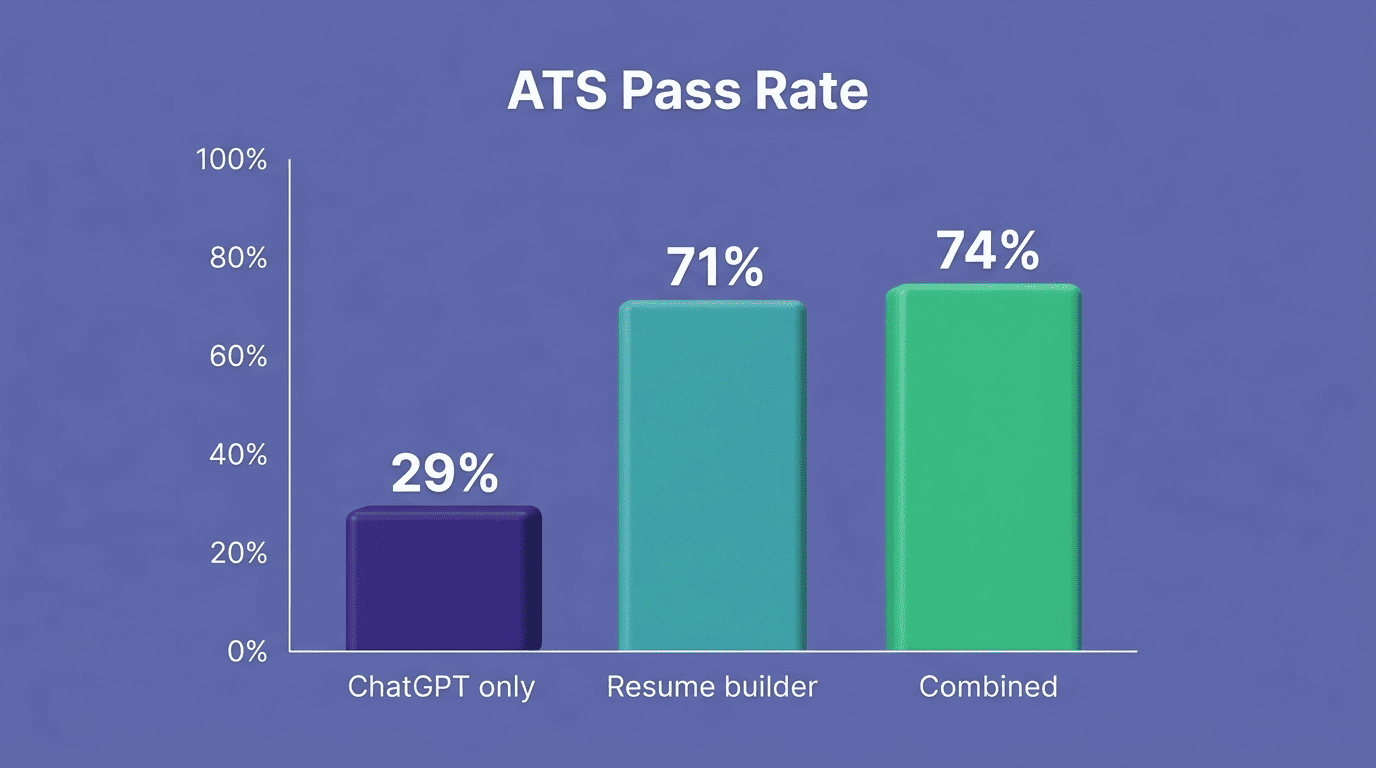
The pass-rate gap. In one published head-to-head test — 30 professionals tracked over three weeks by a resume-tool vendor, not an independent or peer-reviewed study — resumes built with a dedicated tool passed ATS parsing about 71% of the time versus roughly 29% for ChatGPT-only resumes; combining both nudged it to ~74%. Take the exact figures as directional rather than universal, but the underlying pattern — that formatting, not wording, decides most parsing failures — shows up consistently across ATS testing generally. Separately, around 98% of Fortune 500 companies screen with an Applicant Tracking System, so parsing failures happen before a human ever reads the resume.
Why ChatGPT struggles with ATS. Left to its own defaults, ChatGPT tends to output formatting that ATS parsers mangle, including:
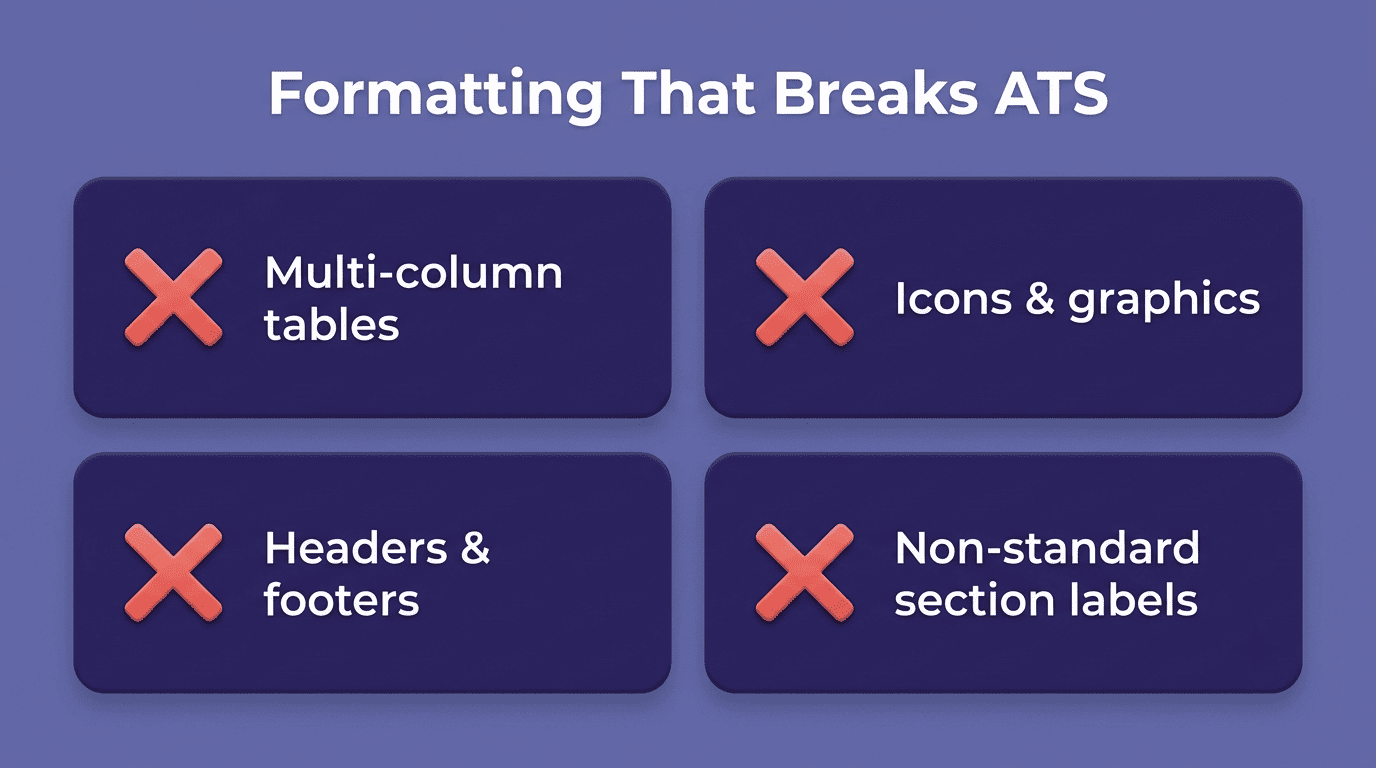
- Multi-column tables and side-by-side sections
- Icons, graphics, or decorative dividers
- Headers or footers holding contact details the parser never reads
- Non-standard section labels the parser doesn’t recognize
A single-column layout is the safest for parsing. Builders enforce this by default; with ChatGPT you have to know the rules and format manually. ATS parsers read a resume in a strict, linear order, and anything that breaks that order breaks the extraction — which is why tables and multi-column blocks are the single most common cause of a mangled parse.
When you introduce a table, you are asking the software to understand a two-dimensional grid.
Jobscan
Different platforms enforce these rules to different degrees, which is part of why pass rates vary so widely between them. Greenhouse, Lever, and Workday are three of the most widely deployed applicant tracking systems, and each parses a resume slightly differently depending on how strictly it expects linear, single-column text.
Testing the same resume against multiple platforms exposes the pattern clearly: a document that parses perfectly in one ATS can still lose entire sections in another. That inconsistency is why a resume maker that tests across several parsers ends up safer than a one-size-fits-all format built by hand. The same vendor test cited above broke its results down by platform:
| ATS platform | ChatGPT-formatted resume | Builder-formatted resume |
|---|---|---|
| Greenhouse | ~40% parsed cleanly | ~90% parsed cleanly |
| Lever | ~30% parsed cleanly | ~80% parsed cleanly |
| Workday | ~20% parsed cleanly | ~70% parsed cleanly |
Treat these exact numbers as one test’s results rather than a universal benchmark, but the direction is consistent with ATS testing more broadly: the harder the parser, the wider the gap tends to be between a hand-formatted document and one generated by a resume maker that already knows the parser’s quirks.
Round 2 — Speed and Effort
Formatting isn’t just a quality issue — it’s a time sink, and the two tools differ by an order of magnitude here.
Time to a finished resume
In the same vendor test, testers spent about 69 minutes with ChatGPT (largely on manual formatting, which alone added roughly 47 minutes) versus about 12 minutes with a builder. Re-tailoring for each new job took 25-40 minutes in ChatGPT versus 3-5 minutes in a builder that keeps your data and swaps keywords. Again, treat the exact minutes as one test’s numbers rather than a fixed rule, but the order-of-magnitude gap matches the structural reason below.
Why the gap is structural, not a skill issue
A resume builder stores your work history once and re-targets it against a new job description / keyword matching engine automatically. ChatGPT has no memory of your formatting choices between sessions unless you rebuild the prompt each time, which is why per-application tailoring keeps costing 25-40 minutes no matter how experienced the user gets. The time saved compounds fast for anyone applying to more than a handful of roles.
Round 3 — Writing Quality, Truthfulness, and Hallucinations
Phrasing is the one category where the general-purpose model genuinely competes — and where its biggest risk also lives.
Where ChatGPT shines. ChatGPT is genuinely strong at brainstorming accomplishments, rewriting weak bullets into action-verb STAR method statements, and adjusting tone. For raw phrasing it scores near the top in head-to-head tests, and it’s a fast way to turn a vague sentence into a quantified bullet point.
The hallucination risk. Left unchecked, a general model will invent job titles, dates, certifications, or metrics that were never in your history — a serious problem on a document a recruiter can fact-check. Common failure points include:
- A job title upgraded to sound more senior than it was
- A metric or percentage that was never measured
- A certification or degree the person doesn’t actually hold
- Dates adjusted to close an employment gap
Builders constrain output to the experience you actually enter, which lowers this risk substantially.
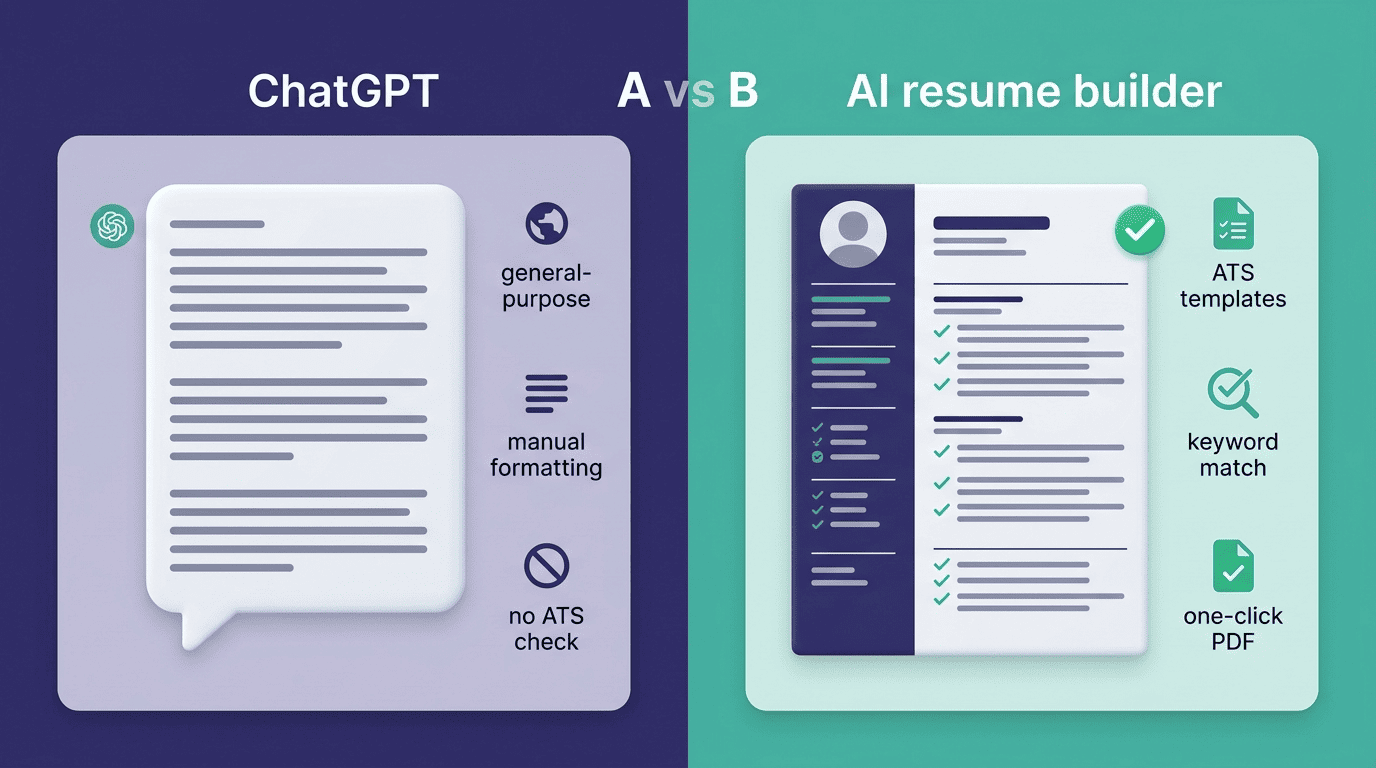
That distinction — writer versus builder — is the thread running through every round of this comparison. The Society for Human Resource Management makes a related point in its own guidance on using AI for resumes: AI can help optimize keywords and highlight skills, but it is a supplement to human judgment, not a replacement for it — which is exactly why the verification step below matters.
Round 4 — Price
Cost rarely decides this comparison on its own, since the two tools land in a similar range.
| Tool | Typical monthly cost |
|---|---|
| ChatGPT (free tier) | $0 |
| ChatGPT Plus | ~$20/month |
| Claude Pro | $20/month (~$17/month billed annually) |
| Dedicated AI resume builder | ~$20-29/month (many offer free tiers or free exports) |
ChatGPT has a free tier; ChatGPT Plus is about $20/month and Claude Pro is $20/month, or about $17/month if billed annually. Dedicated builders typically run about $20-29/month, though several offer free tiers or free exports. Price is close enough that the decision usually comes down to fit, not cost.
The Verdict — and the Hybrid Workflow That Beats Both
Neither tool used alone produces the best outcome. The data points toward combining them deliberately rather than picking a side.
Why hybrid wins
Broader industry data points the same direction: fully AI-generated resumes tend to land noticeably fewer callbacks than resumes a human has personalized or edited, while a hybrid approach — brainstorm and phrase with ChatGPT, then build, structure, and ATS-check in a dedicated builder — tends to outperform both used alone. In the same vendor test cited earlier, hiring-manager quality scores followed that order: 6.4/10 for ChatGPT-only resumes, 8.2/10 for builder-only resumes, and 8.6/10 for the combined approach — again, one test’s numbers, not an industry-wide benchmark. About 62% of hiring managers in a Resume Now survey said they’d reject an AI-generated resume that wasn’t personalized to the role, so a human final edit matters regardless of which tool did the first draft.
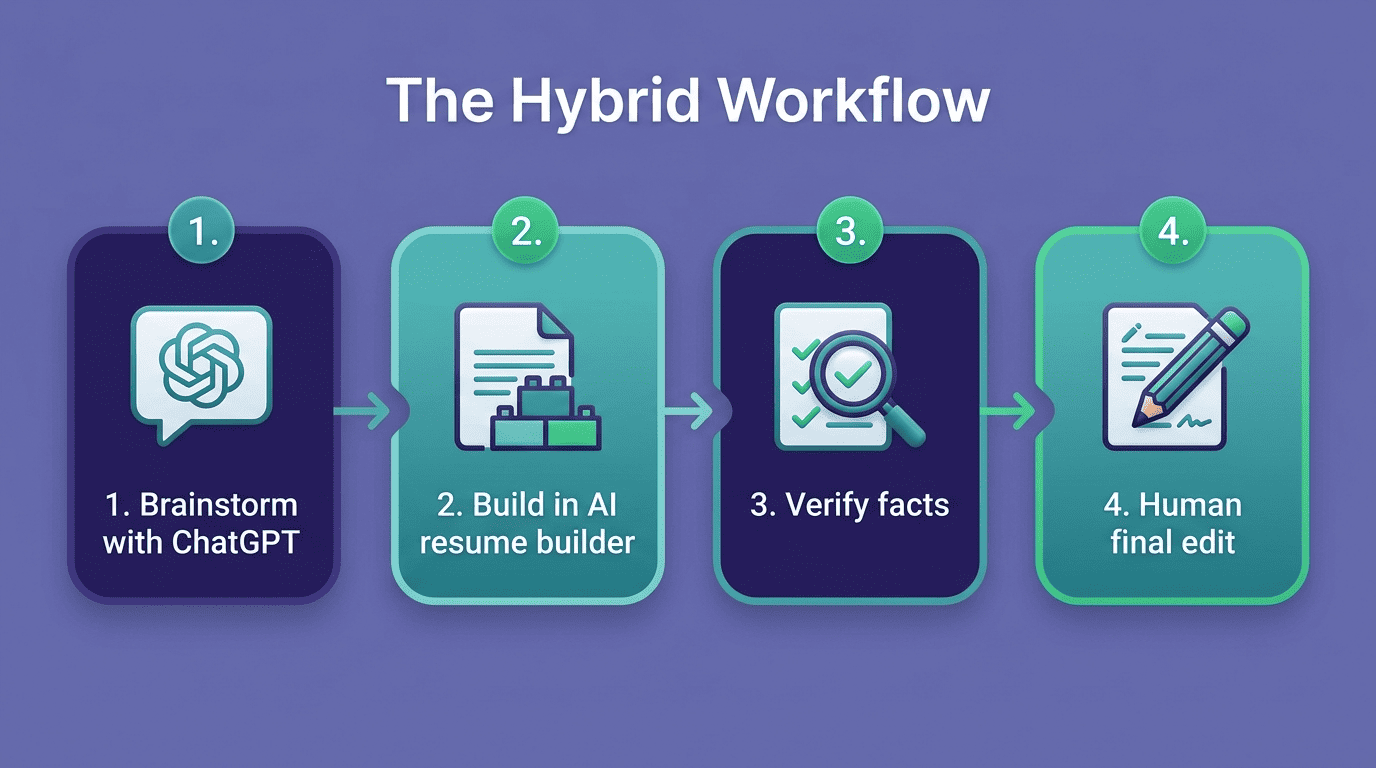
The recommended process
- Brainstorm accomplishments and rough bullets with ChatGPT.
- Move them into an AI resume builder for ATS-safe structure, keyword targeting, and export.
- Verify every number, title, and date against reality.
- Do a human final pass for voice.
This four-step sequence is short enough to repeat for every application, and it’s the version of «using AI» that hiring managers consistently rate higher than either tool alone.