Is It Safe to Use an AI Resume Builder? Honesty, ATS, and Getting Hired
Yes — using an AI resume builder is safe, and in 2026 it’s practically standard, as long as it structures your real experience instead of inventing it. No mainstream applicant tracking system detects AI authorship, and a large field study led by MIT Sloan researchers found that algorithmic writing help actually raised hire rates rather than hurting them.

The real risk was never «getting caught by software.» It’s writing that sounds generic, or claims that fall apart the moment an interviewer asks a follow-up question. This guide walks through what ATS actually checks, how reliable AI detectors are, what recruiters say when surveyed, and how to use an AI-powered resume writer without crossing the line into dishonesty.
Can an ATS Detect an AI-Written Resume?
The short answer: no
No major applicant tracking system natively flags whether AI wrote your resume, including the platforms that dominate corporate hiring:
- Workday
- Greenhouse
- iCIMS
- SAP SuccessFactors
An ATS parses your file into structured fields and ranks how well those fields match a job description. Roughly 97.8% of Fortune 500 companies run one, and a large share of employers now layer some form of AI into hiring — a 2023 SHRM survey put AI use in the hiring process at around 79% — but that ranking layer scores relevance and keyword match, not provenance. The system was built to answer «does this candidate fit the role,» not «who typed this.»
That distinction matters because it changes what you should actually optimize for. An ATS doesn’t reward or punish AI involvement; it rewards a clean, parseable file that mirrors the language of the job posting. A resume written entirely by a human but formatted in a two-column layout with graphics can score worse in an ATS than an AI-drafted one saved as a clean single-column .docx. Formatting, not authorship, is what the software measures.
Do AI Detectors Actually Work?
Standalone AI-text detectors are the tools people worry about most, and the evidence says they shouldn’t be trusted for a hiring decision.
OpenAI’s own classifier reached only about 26% accuracy at identifying AI-written text before the company shut it down in July 2023, after it also mislabeled 9% of genuinely human writing as AI-generated. A study associated with Stanford found that detectors wrongly flagged roughly 61% of essays written by non-native English speakers as AI-generated — a bias problem that makes these tools especially unreliable for a global, multilingual job market.
The false positives get almost absurd at the extreme:
| Text checked | Detector result |
|---|---|
| U.S. Declaration of Independence | ~98% AI-written |
| U.S. Constitution | ~92% machine-generated |
| Non-native-English TOEFL essays (Stanford study) | ~61% wrongly flagged as AI |
| Human writing checked by OpenAI’s classifier | 9% mislabeled as AI |
Because the error rate runs in both directions — missing real AI text and flagging honest human writing — few recruiting teams build detector output into a rejection decision. Most large employers treat a detector score as a weak signal at best, not grounds to auto-reject a candidate who may simply write in a different register than the tool expects.
This matters most for candidates the tools get wrong most often. Non-native English speakers, technical writers who favor short, uniform sentences, and anyone who leans on a spell-checker or grammar assistant can all trigger a false «AI-written» flag. A study associated with Stanford, examining exactly this bias problem, put it plainly.
GPT detectors consistently misclassify non-native English writing samples as AI-generated, whereas native writing samples are accurately identified.
Liang et al., «GPT detectors are biased against non-native English writers,» Stanford University
That gap between confident-sounding detector scores and actual reliability is why almost no hiring pipeline treats a detector flag as proof of anything. The tools people mention most often fall into the same category of «flag, don’t decide»:
- GPTZero
- ZeroGPT
- Originality.ai
Each can highlight a document for a closer human read, but none of them is accurate enough to be the reason a real candidate gets rejected.
What Do Recruiters Actually Think?
They don’t hate AI — they hate generic
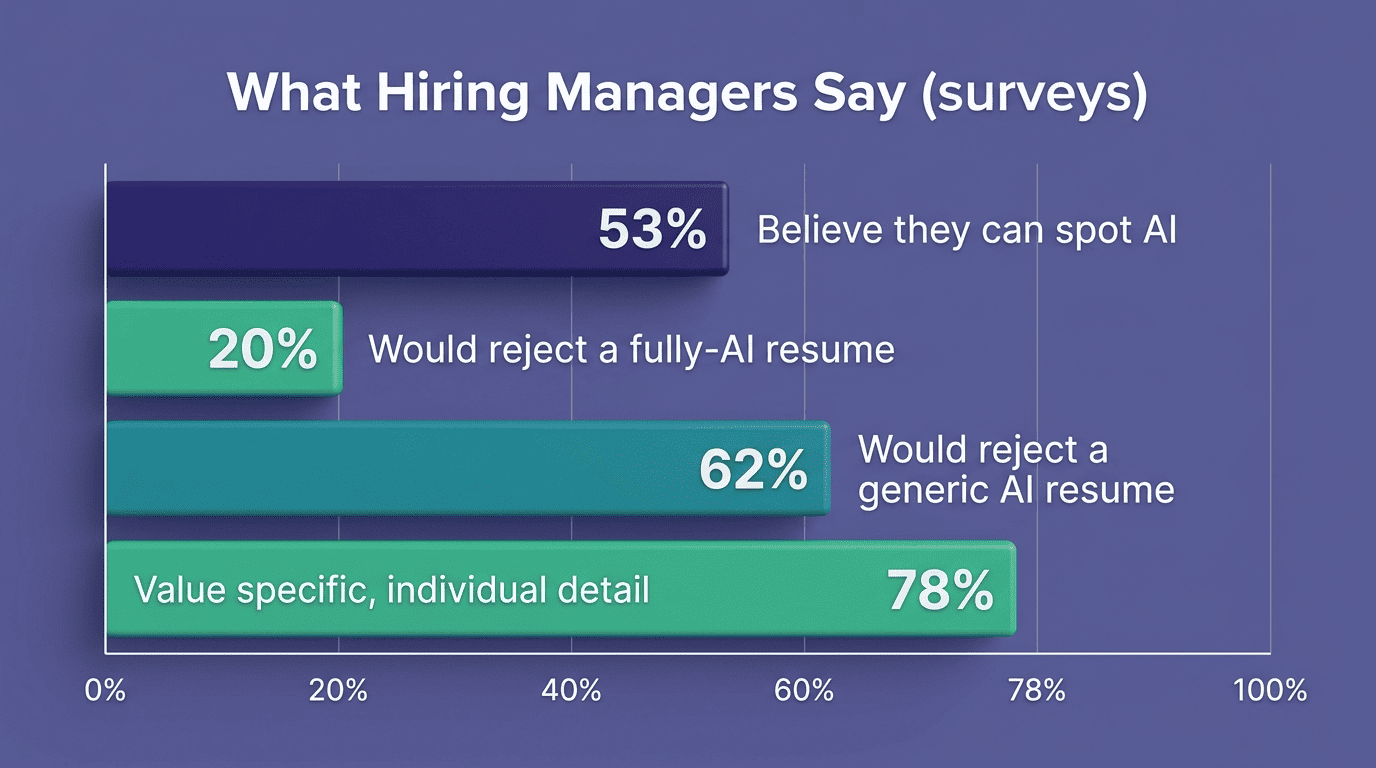
Recruiter sentiment is more nuanced than «AI resumes get rejected.» About 53% of hiring managers say they believe they can tell when AI was used, according to an Insight Global survey, yet only around 19.6% would reject a fully AI-written resume outright, and 52% say they’re fine with AI helping draft the content, according to a TopResume survey. What actually triggers rejection is the absence of personalization: an industry survey from Resume Now found 62% of hiring professionals would reject a resume that reads as generic AI output, while 78% say they specifically value concrete, individual detail. A widely cited eye-tracking study once clocked the average first resume screen at about 7.4 seconds — however long the real number is today, sameness, not AI use, is what gets a resume discarded that fast.
| What recruiters say | Share who report it |
|---|---|
| Believe they can spot AI-written text | ~53% |
| Would reject a fully AI-written resume | ~19.6% |
| Are comfortable with AI-assisted drafting | ~52% |
| Would reject a generic, un-personalized AI resume | ~62% |
| Say specific, individual detail matters | ~78% |
Is It Honest — or Is It Cheating?
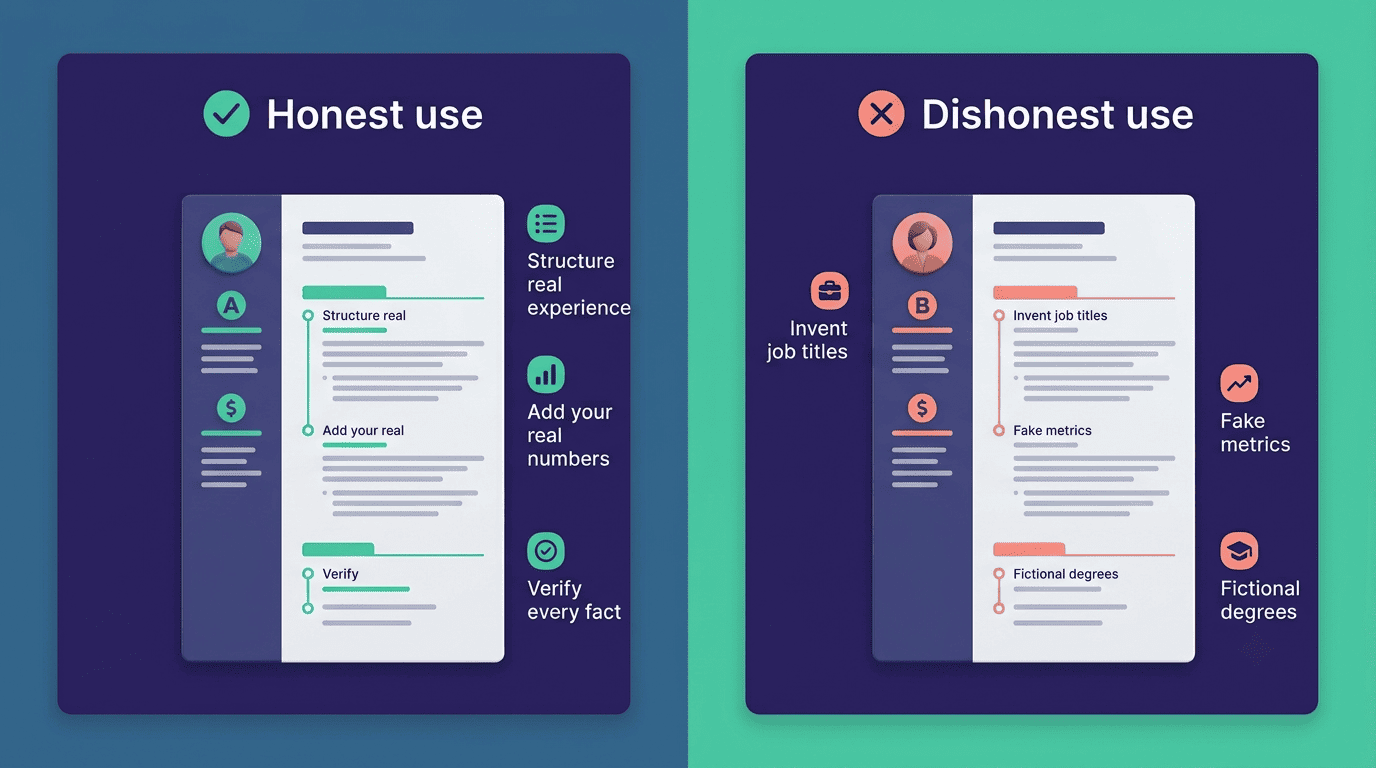
Using an AI resume builder is honest when it takes things you actually did and helps you word and structure them clearly. It becomes dishonest — and risky — the moment it invents any of the following:
- A job title you never held
- A metric or outcome you never measured
- A certification you never earned
- A school or degree you never attended
Fabrications rarely get caught by software. They get caught in the interview, when a hiring manager asks you to walk through the «40% efficiency gain» line item and you can’t explain how you measured it, or during a reference check that can’t verify a role at a company you never worked for. The safest mental model is to treat AI the way you’d treat spellcheck: a tool that improves how you say something, never a source for what you say. Before you submit anything, you should be able to explain every line out loud, unscripted.
The second, quieter honesty problem is «sameness.» Reviewers who screen hundreds of resumes a week start recognizing the same five verbs and the same suspiciously round numbers — «spearheaded,» «leveraged,» «increased efficiency by 30%» — appearing across unrelated candidates. That pattern doesn’t just look automated; it reads as low-effort, which is its own form of rejection risk even when every fact underneath is true.
Does It Help or Hurt Your Chances of Getting Hired?
The evidence says it helps
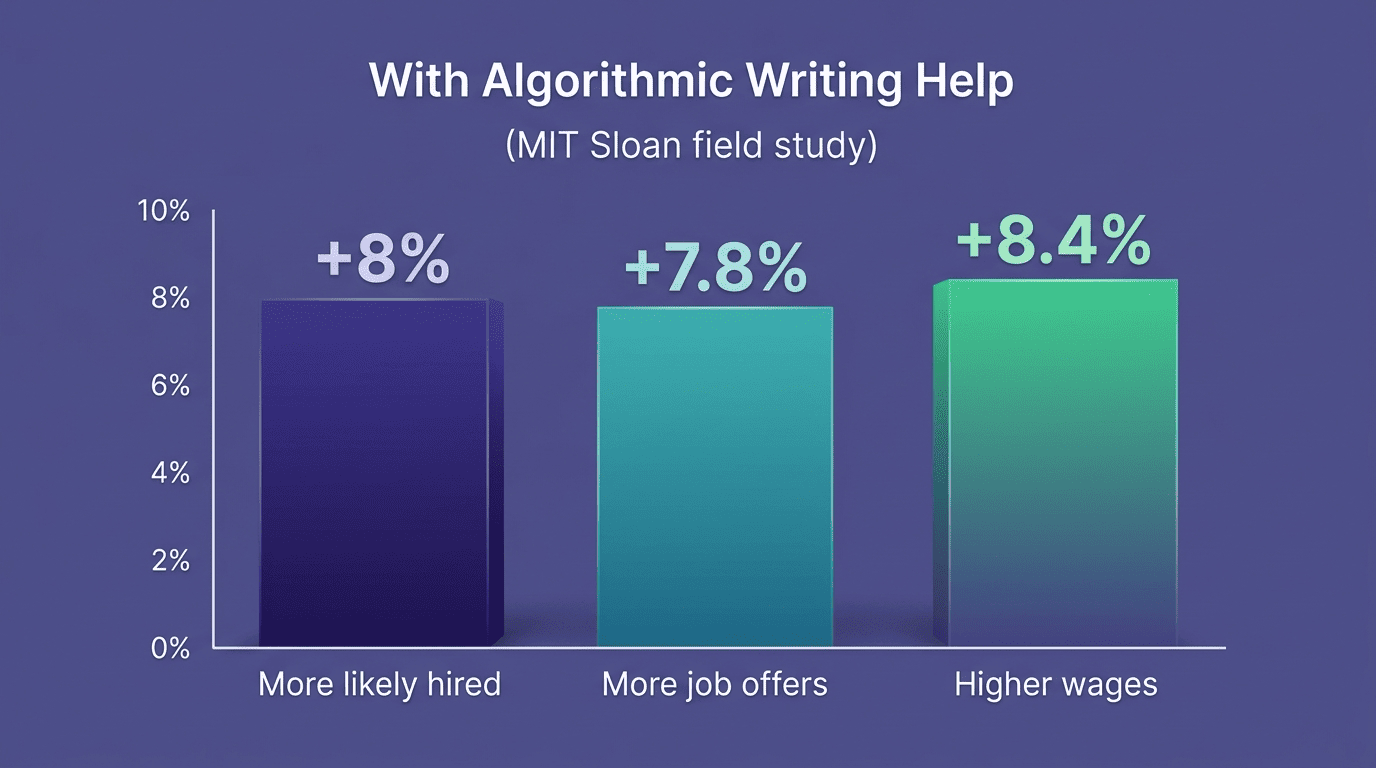
A large field experiment led by researchers affiliated with MIT Sloan, covering roughly 480,948 job seekers, measured three outcomes for the group given algorithmic writing help, compared with a control group that had none:
- About 8% more likely to be hired
- 7.8% more job offers received
- 8.4% higher starting wages
None of that came at the employer’s expense — the study found no measurable drop in employer satisfaction with the hires. Adoption has followed the data: about 29.3% of job seekers now report using AI somewhere in their resume process, up from 17.3% not long before.
That lift isn’t automatic, though. It shows up when AI is used to clarify and structure genuine accomplishments — the exact opposite of the generic, fabricated pattern recruiters say they reject. The tool amplifies whatever content you feed it: real, specific achievements get sharper; vague or invented ones just get more confidently wrong.
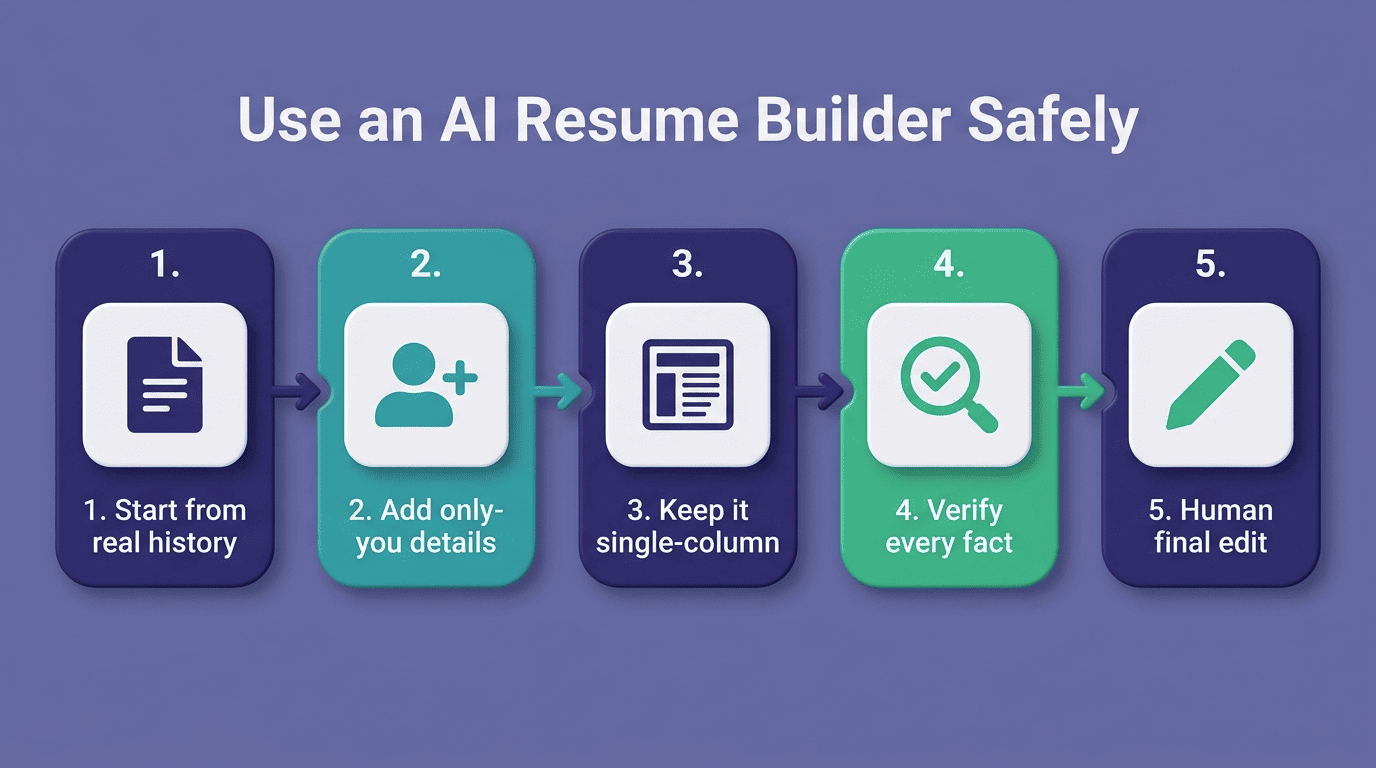
How to Use an AI Resume Builder Safely
The mechanics of safe use are simple enough to follow as a short checklist before you submit anything.
- Start from your real work history — never let the tool invent a title, employer, or credential.
- Add the specific, only-you details AI has no way to know: exact numbers, project names, and outcomes.
- Keep the formatting ATS-safe — two-column layouts, tables, and sidebars are widely reported to parse less reliably than a simple single column, so stick to one column.
- Save and submit as a .docx where possible; a clean .docx generally extracts more reliably than a PDF, which can garble on some ATS platforms — especially PDFs with unusual fonts, columns, or embedded graphics.
- Verify every number, title, and date against your actual record before you submit.
- Do a final human pass so the language sounds like you, not a template everyone else is also using.
- Check the resume tool’s own privacy and data-retention policy before you upload personal information, references, or contact details.
Following this sequence keeps the tool doing what it’s good at — structure, phrasing, formatting — while you stay the source of every fact on the page.